Adapted from P. Coles, 1999, The Routledge Critical Dictionary of the New Cosmology, Routledge Inc., New York. Reprinted with the author's permission. To order this book click here: http://www.routledge-ny.com/books.cfm?isbn=0415923549
The standard Big Bang theory is based on the assumption that the Universe is, on sufficiently large scales, homogeneous and isotropic. This assumption goes under the grand-sounding name of the cosmological principle. The name, however, belies the rather pragmatic motivations that led the early relativistic cosmologists to introduce it. Having virtually no data to go on, Albert Einstein, Alexander Friedmann, Georges Lemaître and the rest simply chose to explore the simplest cosmological models they could find. Somewhat fortuitously, it seems that the Universe is reasonably compatible with these simple models.
More recently, cosmologists started to ask whether homogeneity could be explained within the Big Bang theory rather than simply being assumed at the start. The prospects appear fairly promising: there are many physical processes that we can imagine having smoothed out any fluctuations in the early Universe, in much the same way that inhomogeneous media reach a homogeneous state, for example by diffusion. But there is a fundamental problem that arises when we appeal to these processes in cosmology: diffusion or other physical homogenisation mechanisms take time. And in the early stages of the rapid expansion of the Universe there does not seem to have been enough time for these mechanisms to come into play.
This shortage of time is indicated by the presence of cosmological (particle) horizons. Even the most rapid process for smoothing out fluctuations cannot occur more quickly over a scale L than the time it takes light to traverse that scale. Therefore, assuming that the initial state of the Universe was not homogeneous, we should expect it to remain inhomogeneous on a scale L unless the horizon is large enough to encompass L. Roughly speaking, this means that L > ct for homogenisation to occur at some time t. But the cosmological particle horizon grows in proportion to time t in the standard Friedmann models, while the proper distance between two points moving with the expansion scales with t more slowly than this. (For example, in the Friedmann model describing a flat universe - the Einstein-de Sitter solution - the proper distance between points scales as t2/3.)
The existence of a cosmological horizon makes it difficult to accept
that the cosmological principle results from a physical process. This
principle requires that there should be a very strong correlation
between the physical conditions in regions which are outside each
other's particle horizons and which, therefore, have never been able
to communicate by causal processes. For example, the observed isotropy
of the cosmic microwave background radiation implies that this
radiation was homogeneous and isotropic in regions on the last
scattering surface (i.e. the spherical surface centred upon us, here
on Earth, which is at a distance corresponding to the lookback time to
the era at which this radiation was last scattered by matter). The
last scattering probably took place at a cosmic epoch characterised by
some time tls corresponding to a redshift of
zls  1000. The distance
of the last scattering surface is now roughly ct0,
since the time of
last scattering was very soon after the Big Bang singularity. Picture
a sphere delimited by this surface. The size of the sphere at the
epoch when the last scattering occurred was actually smaller than its
present size because it has been participating since then in the
expansion of the Universe. At the epoch of last scattering the sphere
had a radius given roughly by ct0 / (1 +
zls). This is about one-tenth
the size of the particle horizon at the same epoch. But our last
scattering sphere seems smooth and uniform. How did this happen, when
different parts of it have never been able to exchange signals with
each other in order to cause homogenisation?
1000. The distance
of the last scattering surface is now roughly ct0,
since the time of
last scattering was very soon after the Big Bang singularity. Picture
a sphere delimited by this surface. The size of the sphere at the
epoch when the last scattering occurred was actually smaller than its
present size because it has been participating since then in the
expansion of the Universe. At the epoch of last scattering the sphere
had a radius given roughly by ct0 / (1 +
zls). This is about one-tenth
the size of the particle horizon at the same epoch. But our last
scattering sphere seems smooth and uniform. How did this happen, when
different parts of it have never been able to exchange signals with
each other in order to cause homogenisation?
Various avenues have been explored in attempts to find a resolution of this problem. Some homogeneous but anisotropic cosmological models do not have a particle horizon at all. One famous example is the mixmaster universe model proposed by Charles Misner. Other possibilities are to invoke some kind of modification of Einstein's equations to remove the horizon, or some process connected with the creation of particles at the Planck epoch of quantum gravity that might lead to a suppression of fluctuations. Indeed, we might wonder whether it makes sense to talk about a horizon at all during the era governed by quantum cosmology. It is generally accepted that the distinct causal structure of spacetime that is responsible for the behaviour of light signals (described by the signature of the metric) might break down entirely, so the idea of a horizon becomes entirely meaningless (see e.g. imaginary time).
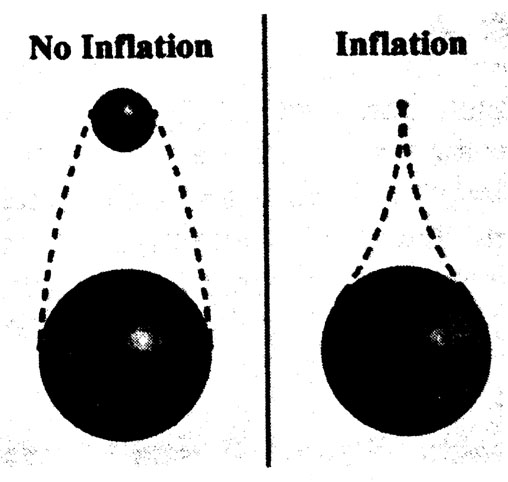
The most favoured way of ironing out any fluctuations in the early Universe, however, is generally accepted to be the inflationary Universe scenario. The horizon problem in the standard models stems from the fact that the expansion is invariably decelerating in the usual Friedmann models. This means that when we look at the early Universe the horizon is always smaller, compared with the distance between two points moving with the expansion, than it is now. Points simply do not get closer together quickly enough, as we turn the clock back, to be forced into a situation where they can communicate. Inflation causes the expansion of the Universe to accelerate. Regions of a given size now come from much smaller initial regions in these models than they do in the standard, decelerating models. This difference is illustrated in the Figure by the convex curves showing expansion in the inflationary model, and the concave curves with no inflation.
Horizon problem. Our observable patch of the Universe grows from a much smaller initial patch in the inflationary Universe (right) than it does in the standard Friedmann models (left.). |
With the aid of inflation, we can make models in which the present-day Universe comes from a patch of the initial Universe that is sufficiently small to have been smoothed out by physics rather than by cosmological decree. Interestingly, though, having smoothed away any fluctuations in this way, inflation puts some other fluctuations in their place. These are the so-called primordial density fluctuations which might be responsible for cosmological structure formation. The difference with these fluctuations, however, is that they are small - only one part in a hundred thousand or so - whereas we might have expected the initial pre-inflation state of the Universe to be arbitrarily large.
FURTHER READING:
Guth, A.H., `Inflationary universe: A possible solution to the horizon and flatness problems', Physical Review D, 1981, 23, 347. Narlikar, J.V. and Padmanabhan, T., `Inflation for astronomers', Annual Reviews of Astronomy and Astrophysics, 1991, 29, 325.