


2.1.3. Ionization of the Disk Surface
X-ray irradiation can photoionize the surface layers of a disk (Ross & Fabian 1993; Ross, Fabian & Young 1999). As discussed above, the fluorescent line that the illuminated matter produces depends upon its ionization state. A useful quantity in this discussion is the ionization parameter

where Fx(r) is the X-ray
flux received per unit area of the disc at a radius r, and
n(r) is
the comoving electron number density: it measures the ratio of the
photoionization rate (which is proportional to n) to the
recombination rate (proportional to n2). The iron line
emission for
various ionization parameters has been investigated by Matt et al
(1993,
1996).
They found that the behaviour split into four regimes
depending on the value of  (also see Fig. 2).
< 100 ergs
cm s-1: The material is weakly ionized.
X-ray reflection from the accretion disk produces a cold iron line at
6.4 keV. Since the total photoelectric opacity of the material is
large even below the iron edge, the Compton backscattered continuum
only weakly contributes to the observed spectrum at 6 keV, and the
observed iron K-shell absorption edge is small. This regime is termed
`cold' reflection, since the reflection spectrum around the energy of
the iron-K features resembles that from cold, neutral gas.
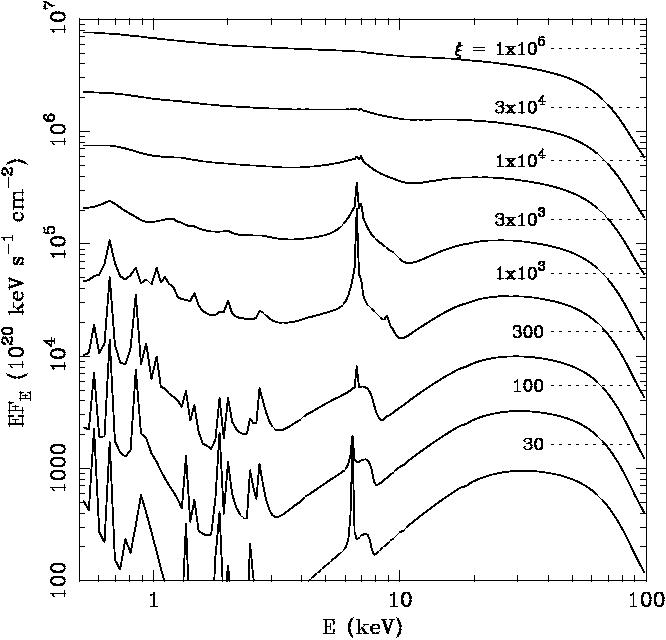
|
Figure 2. Reflection spectra from ionized
matter for various values of the ionization parameter
|
< 500 ergs cm
s-1: In this
intermediate regime, the iron is in the form of FeXVII-FeXXIII and
there is a vacancy is the L-shell (n = 2) of the ion. Thus, these
ions can resonantly absorb the corresponding
K line photons.
Successive fluorescent emission followed by resonant absorption
effectively traps the photon in the surface layers of the disk until
it is terminated by the Auger effect. Only a few line photons can
escape the disk leading to a very weak iron line. The reduced
opacity below the iron edge due to ionization of the lower-Z
elements leads to a moderate iron absorption edge.
line photons.
Successive fluorescent emission followed by resonant absorption
effectively traps the photon in the surface layers of the disk until
it is terminated by the Auger effect. Only a few line photons can
escape the disk leading to a very weak iron line. The reduced
opacity below the iron edge due to ionization of the lower-Z
elements leads to a moderate iron absorption edge.
< 5000 ergs
cm s-1: In this
regime, the ions are too highly ionized to permit the Auger effect.
While the line photons are still subject to resonant scattering, the
lack of a destruction mechanism ensurs that they can escape the disk
and produces a `hot' iron line at ~ 6.8 keV. There is a large
absorption edge.
> 5000 ergs
cms-1: When the disk is highly ionized,
it does not produce an iron line because the iron is completely
ionized. There is no absorption edge.
Note that ionization of the reflector paradoxically causes the
observed iron edge to strengthen at moderate values of
. This
is because the edge is saturated in reflection from a cold absorber,
as is absorption at lower energies where oxygen and iron-L are the
main absorbers. Ionization of oxygen and iron leads to the iron-K edge
being revealed, and so apparently becoming stronger, as the reflected
flux below the edge increases.
The Matt et al. (1993, 1996) calculations assume a fixed density structure in the atmosphere of the accretion disk. Nayakshin, Kallman & Kazanas (1999) have relaxed this assumption and included the effect of thermal instability in the irradiated disk atmosphere. In their solutions, the cold dense disk that produces the X-ray reflection features is blanketed with an overlying low-density, highly ionized, region. For weak irradiation, the ionized blanket is thin and does not affect the observed spectrum. However, for strong irradiation, the ionized blanket scatters and smears the ionized reflection features. In their models, it can be difficult to produce highly ionized iron lines in reflection - the effect of increasing ionization is to dilute the `cold' reflection signature. The extent of this effect will depend on the Compton temperature of the radiation field.