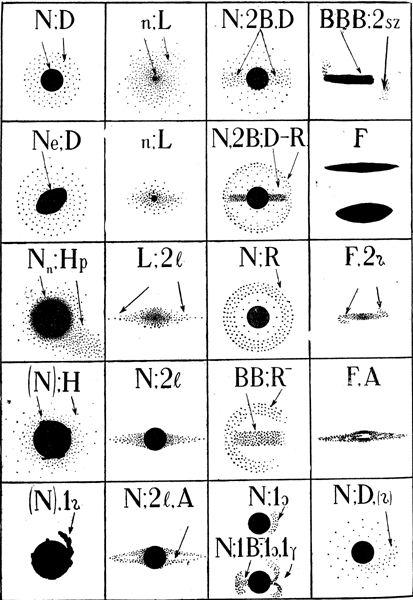
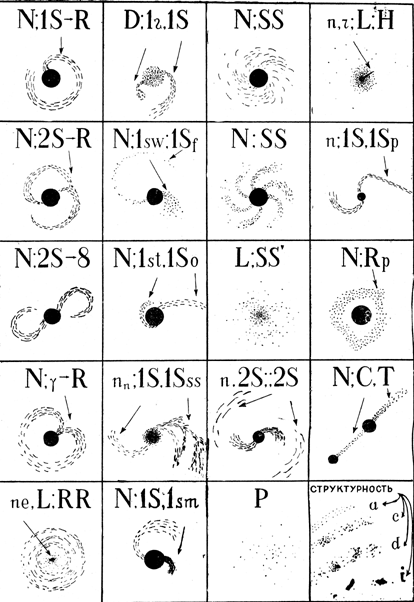
| Symbol used in MCG | Description |
|---|---|
| E | elliptical |
| F | flat galaxies usually highly inclined, with no distinguishable form |
| G | small galaxies, difficult to describe but not stellar |
| N | large nucleus |
| n | small nucleus |
| Ne and ne | elongated nuclei |
| (N) | overexposed image with traces of structure which imitate a nucleus |
| Nn and nn | nebulous nuclei |
| H | haze or halo |
| Hp | very asymmetrical or disturbez Haze |
| D | disk |
| D- | incomplete disk |
| L | lens |
| R | ring |
| RR | several rings |
| R- | incomplete ring |
| D ->R | disk is brighter at its rim (ring effect) |
| B | short bar with no nucleus |
| B- | very short bar |
| BB | long bar |
| BBB | very long bar |
| 2B | bar seen on both sides of N or L |
| N;2B | bar is faint relative to nucleus |
| N,2B | nucleus and bar are of comparable strength |
| S and Z | long spiral arms 2S = two arms, 3S = three spiral arms, etc. |
| s and z | short spiral arms |
| SS and zz | indefinite numbers of arms |
| SS' and ss' | arms with indefinite direction of winding |
| ZS | arms wind in opposite directions |
| Sss | branching spiral arm |
| r | ray |
 | emergent
spiral arms
form a -shape |
| -> R | -arm tends to form a ring |
| 2S -> 8 | spiral returns to nucleus forming a figure-eight |
| S -> R | arm merges into a ring |
| (N);ss or F;ss | ends of a flat system are visible |
| D, (2S) or L, (2s) | arms are suspected in a D or L system |
| 2l | two wings (flattened component seen edge-on) |
| P | indefinite patch |
| A | absorption feature |
| T | tail |
| C | connecting filament (in interacting systems) |
| +* | star superimposed |
| m | massive |
| f | filamentary |
| w | wide open arms |
| t | tightly wound arms |
| o | open arms |
| z | arms start at right-angles to the bar |
| -> | appears to transform to |
| -> 8 | transforms to a figure-eight or loop |
| a | very smooth |
| b | smooth |
| c | patchy |
| d | very patchy |
| i | irregular patchiness |
| p | deformed detail (not the peculiarity in general)
used to accentuate any particular detail |
| ( ) | symbols are put in parentheses when a detail is only suspected |