

|
|
| © CAMBRIDGE UNIVERSITY PRESS 1998 |
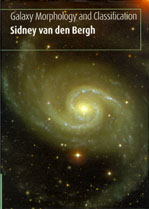
| GALAXY MORPHOLOGY AND CLASSIFICATIONSidney van den BerghDominion Astrophysical Observatory Herzberg Institute of Astrophysics National Research Council of Canada |
In co-operation with Cambridge University Press the Introductory chapter to this book is being made freely available for viewing by LEVEL5 users. Further details on the full text can be obtained from CUP.
ABSTRACT. The classification of galaxies according to their shape is a fundamental tool in astronomy. It is through classification schemes that astronomers build a deeper understanding of how galaxies form and evolve. This long-awaited book by one of the pioneers of the field provides a concise and up-to-date summary of current ideas about galaxy morphology and classification.
This is the first book to be dedicated entirely to the shapes and classifications of galaxies. It introduces the most widely used schemes (including those by Hubble, de Vaucouleurs, Morgan, the author and Elmegreen), explains how they have developed and what they can tell us about galaxies. Professor van den Bergh also presents evidence for how galaxies might `transmute' from one type to another. It is also shown how very distant galaxies (for instance, those seen in the Hubble Deep Field) often defy standard classification schemes. Finally, this book discusses recent work on the use of computers to classify digital images of galaxies automatically.
This topical volume provides graduate students and researchers with a unique and indispensable reference on the classification and shape of galaxies.
Table of Contents
For the book's entire chapter contents, please click here.
